
 Facebook
 X
 Pinterest
 Copy Link
If you’ve been comparing condos and townhomes, you’ve probably noticed something: condo association fees are usually higher. Sometimes a lot higher. So why does a condo cost more each month than a townhome, and when is that extra cost actually worth it?
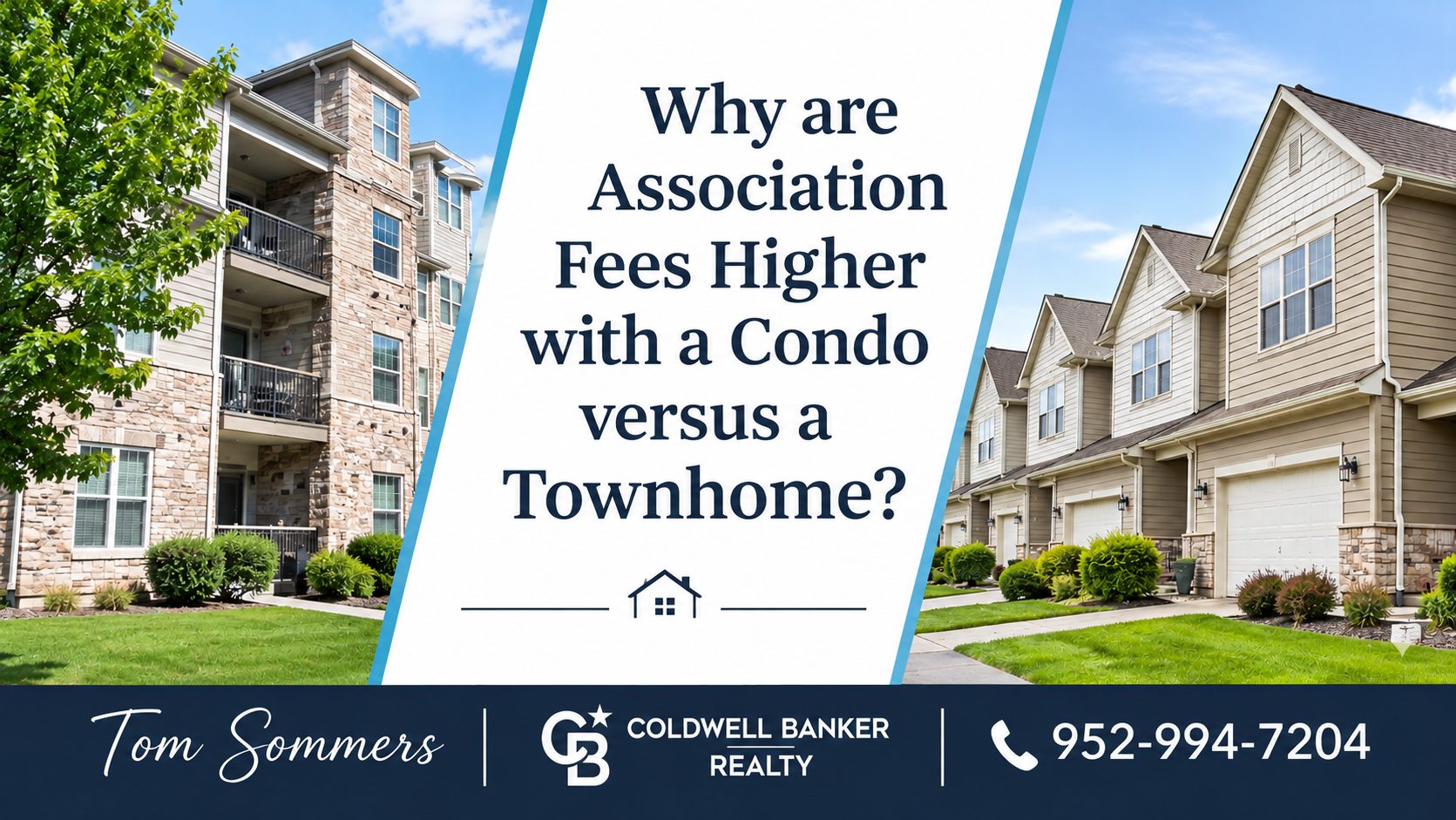
After 24 years of helping buyers in the Twin Cities, here’s what I see driving the difference, and how I protect my clients before they ever make an offer.
Condo vs. Townhome: The Quick Comparison
| What Drives the Fee | Condo | Townhome |
|---|---|---|
| Building insurance | One large building, higher risk, higher premiums | Smaller buildings, often lower premiums |
| Amenities | Often pools, gyms, party rooms, underground parking | Usually few or none |
| Grounds | Large buildings often sit on big plots with parking lots and landscaping | Units packed side by side on less land |
| Utilities | Heat is often included in older buildings | Almost never includes heat |
1. Insurance Is the Biggest Factor
Insurance is usually the single biggest reason condo fees are higher. Insuring one large building full of units costs a lot more than insuring a row of townhomes.
- When units are stacked and packed together, a fire or water leak in one unit can damage many others, which makes claims bigger and premiums higher.
- Age matters. An insurance underwriter who spoke at one of our office meetings told us that once a building hits about 30 years old, premiums tend to climb.
- I’ve seen hazard insurance alone make up more than half of the monthly dues. Not always, but the older the building, the more likely it is.
Know What Your Association Covers
Here’s where condos and townhomes really differ. In a condo, the association’s master policy covers the building. With townhomes, it depends on the association. Most townhome associations I work with include hazard insurance in the fee, but some don’t, and then the owner has to insure the exterior on their own.
Hazard insurance is always the very first thing I talk about when a client wants to buy a condo or townhome. My clients know what’s covered before they make an offer, so they don’t get surprised.
Don’t Forget the Master Policy Deductible
When the association’s policy pays for a claim, the deductible is shared by the owners. I recently heard about a townhome community where, after years of poor management, a roof needed replacing and owners were hit with a $17,000 deductible. Many of them didn’t have coverage for it on their own policy, so they had to pay it out of pocket.
That’s why I tell every buyer to add master policy deductible coverage (often called loss assessment coverage) to their HO-6 policy. It’s a small cost that can save you thousands.
2. Amenities Cost Money to Run
Many condo buildings come with pools, hot tubs, saunas, gyms, party rooms, underground parking, and elevators. They’re great perks, but the association has to staff them, maintain them, insure them, and pay the utilities. All of that shows up in your monthly dues.
Townhome communities rarely have that list of extras, which is a big part of why their fees are usually lower.
3. Older Buildings Playing Catch-Up
Some older condo buildings and townhome communities started out as rentals and were later converted to ownership. Some were poorly managed for decades, and the deferred maintenance piled up.
- By the time the buildings get fixed, the association is behind and playing catch-up.
- I’ve seen monthly dues rise substantially to cover years of neglected repairs.
- That’s why you always have to review the financials to see whether an association is healthy or still catching up.
4. What’s Included in the Fee
Heat being included in the dues surprises a lot of buyers. In many older condo buildings, heat is part of the fee. Newer buildings usually have each unit on its own system, and townhomes almost never include heat.
Included utilities make the fee look higher, so always compare what you’d pay on your own. A higher fee that covers heat isn’t the same as a higher fee that covers nothing extra.
When Is a Higher Condo Fee Worth It?
In my experience, a higher condo fee makes the most sense when you’re actually using what it pays for. That’s often the case in many 55+ communities, where buyers value:
- A built-in sense of community, with lots going on inside the building
- Underground parking
- Elevators and more accessible layouts
- Party or community rooms you can reserve for holidays and get-togethers
When the Math Doesn’t Work
With some older condo buildings, the numbers can be hard to justify. I’ve seen two-bedroom, two-bath condos priced like a great deal, with monthly dues of $600 to $800. Depending on interest rates, dues like that can be about what you’d pay each month on roughly $100,000 more of mortgage.
In other words, a low price with a high fee isn’t always the bargain it looks like. Sometimes a more expensive home with a lower fee, or no fee at all, costs about the same each month.
How I Protect My Clients
Before any client makes an offer on a condo or townhome, I read through the association documents and financials to understand what the fee covers, what the insurance looks like, and whether the association is healthy.
And I always tell my clients this: don’t take any agent’s word for it, mine included. Call the management company or the association and verify anything that matters to you directly with the source. That’s how you remove risk before it becomes a problem.
Watch: Is the Cheapest HOA Always the Best Deal?
Thinking About a Condo or Townhome?
If you’re weighing a condo against a townhome and want help understanding the association fees before you make an offer, I’d be happy to walk you through it. Call or text me at 952-994-7204, or book a time that works for you below.
Related Reading
Why Meeting Minutes Matter When Buying a Condo or Townhome
The Closing Was Supposed to Be Friday. Then the HOA Got Involved
What Mistakes Do Home Buyers Make?
Proudly helping buyers and sellers in:
